
October 2, 2026 · 7 min read
Investor Readiness Legal Services: How a Pre-Fundraising Legal Review Works

If you've read a due diligence checklist and recognised your business in more than a couple of the gaps, the next question isn't "What do investors check?". It's "How do I actually fix this before they do?". That's what a pre-fundraising legal review is for.
This article explains what an Investor Readiness Review actually involves, not as a sales pitch, but as a process, so you know what to expect if you engage one.
The direct answer
A pre-fundraising legal review is a structured assessment of a startup's corporate, ownership, contractual, IP and regulatory position, long before the business goes into investor due diligence. It has four stages: diagnosis, prioritisation, remediation, and readiness confirmation.
The output isn't a report that tells you what's wrong. It's a business whose legal foundation matches what the pitch deck claims, with the highest-risk gaps actually fixed, not just flagged.
Who needs an Investor Readiness Review?
This is most valuable for founders who are:
- Preparing to approach investors within the next few months, not immediately
- Already in conversations and expecting a term sheet or a formal diligence request
- Coming off an informal or friends-and-family round where documentation was never properly closed out
- Operating in a regulated sector (fintech, healthtech) where compliance gaps carry direct commercial risk
- Uncertain whether their existing legal documents actually hold up, having been drafted early, cheaply, or by a lawyer unfamiliar with venture transactions
It's less useful if you're pre-product and years from a raise — though some of the underlying hygiene (proper IP assignment, clean cap table from day one) is worth building early regardless, because it's cheaper to do right the first time than to retrofit later.
Stage 1: Diagnosis
The review starts by comparing what's documented against what's actually true. This means going through:
- CAC records against the company's actual structure, directors and shareholding
- The cap table against every issuance, promise, and informal arrangement made since incorporation
- Existing agreements — shareholders' agreement, founder agreements, employment and contractor terms, key commercial contracts
- IP ownership — who built what, and whether it was properly assigned
- Regulatory position — data protection obligations under the Nigeria Data Protection Act 2023, sector-specific licensing, and Startup Label eligibility under the Nigeria Startup Act 2022
This stage produces a list of gaps. Not all of them matter equally, which is the point of the next stage.
Stage 2: Prioritisation
Not every gap is a dealbreaker, and not every fix takes the same amount of time. A missing signature on a routine vendor contract is a different problem from an unresolved co-founder equity dispute or an IP assignment that was never signed by a contractor who's now unreachable.
This stage sorts findings into three categories:
Fix now — administrative gaps that can be resolved quickly: updating CAC filings, formalising an existing informal agreement, signing documents that were always intended but never executed.
Fix before you raise — structural issues that take real legal work: completing a share allotment, drafting or updating a shareholders' agreement, securing IP assignments from past contributors, addressing a compliance gap.
Disclose and manage — issues that can't be fully resolved before a raise but can be understood, documented, and explained to an investor on your terms, rather than discovered on theirs. Being upfront about a known, well-managed issue is a materially different conversation than an investor finding an undisclosed one.
Stage 3: Remediation
This is where the actual legal work happens — drafting, filing, and formalising. Depending on what Stage 2 surfaces, this can include:
- Increasing share capital
- Completing and filing share allotments so the cap table matches CAC's records
- Drafting or updating a shareholders' agreement
- Securing IP assignment agreements from current and former contributors
- Formalising commercial contracts that were running on informal terms
- Assessing and addressing the business's position under the Nigeria Data Protection Act 2023 and relevant industry regulations
- Applying for a Startup Label where the business qualifies, to secure the associated tax position before it becomes relevant to an investor's terms
Timelines vary considerably here. For example, administrative fixes can close in days and ownership or IP issues involving third parties can take weeks, particularly if a former contributor needs to be tracked down and negotiated with.
Stage 4: Readiness confirmation
Once remediation is complete, the review confirms the business's position is accurate and defensible. It is at this point a founder can walk into a diligence process without wondering what an investor's lawyers might find that they didn't already know about.
This is also the stage where data room preparation happens: organising the now-accurate documents into the structure an investor's team will expect to review, so the process moves quickly instead of generating a stream of follow-up requests.
What an Investor Readiness Review changes commercially
The value isn't the review itself. It's what the review prevents: a due diligence process that drags on for months while gaps get fixed under deadline pressure, a valuation cut because an investor priced in the risk of what they found, or a deal that collapses because a gap turned out to be unfixable in the time available.
Founders sometimes ask whether this is worth doing before they even have investor interest. The honest answer: the earlier the better, because the fixes like license acquisition, IP assignments, cap table corrections, shareholder agreements, that take time are the ones you don't want discovering three weeks before a term sheet expires.
What to have ready before an Investor Readiness Review
You'll get more out of a review, and move through it faster, if you can bring:
- Certificate of incorporation, Memorandum of Association/Articles of Association, and current CAC status report
- Cap table (even an informal spreadsheet version)
- Any existing shareholders' or founder agreements
- Contracts with key customers, vendors, and contractors
- A list of who built the product — employees, contractors, agencies — and whether they signed anything
- Any prior investment documents (SAFEs, convertible notes, term sheets)
If you don't have all of this organised, that's normal. Part of the diagnosis stage is establishing what actually exists versus what's assumed to exist.
Common mistakes founders make before engaging an Investor Readiness Review
1. Waiting until an investor asks. By then, the review is happening under a deadline the investor controls, not you.
2. Assuming the review is a document audit. It's a remediation process. A list of problems without the fixes doesn't change your position going into diligence.
Trying to fix everything internally first, then getting a lawyer to "check it." Some fixes, particularly IP assignments and share allotments, need to be done correctly the first time. Redoing informal fixes costs more time than doing them properly from the start.
Where Leap Wise fits into your Investor Readiness Review process
Preparing your company for an investor conversation or due diligence process? Talk to Leap Wise LP about an Investor Readiness Review. The process runs through your corporate structure, cap table, IP, contracts and compliance, prioritises what actually needs fixing, and gets it done before an investor's due diligence team finds it first.
FAQs on Investor Readiness Review
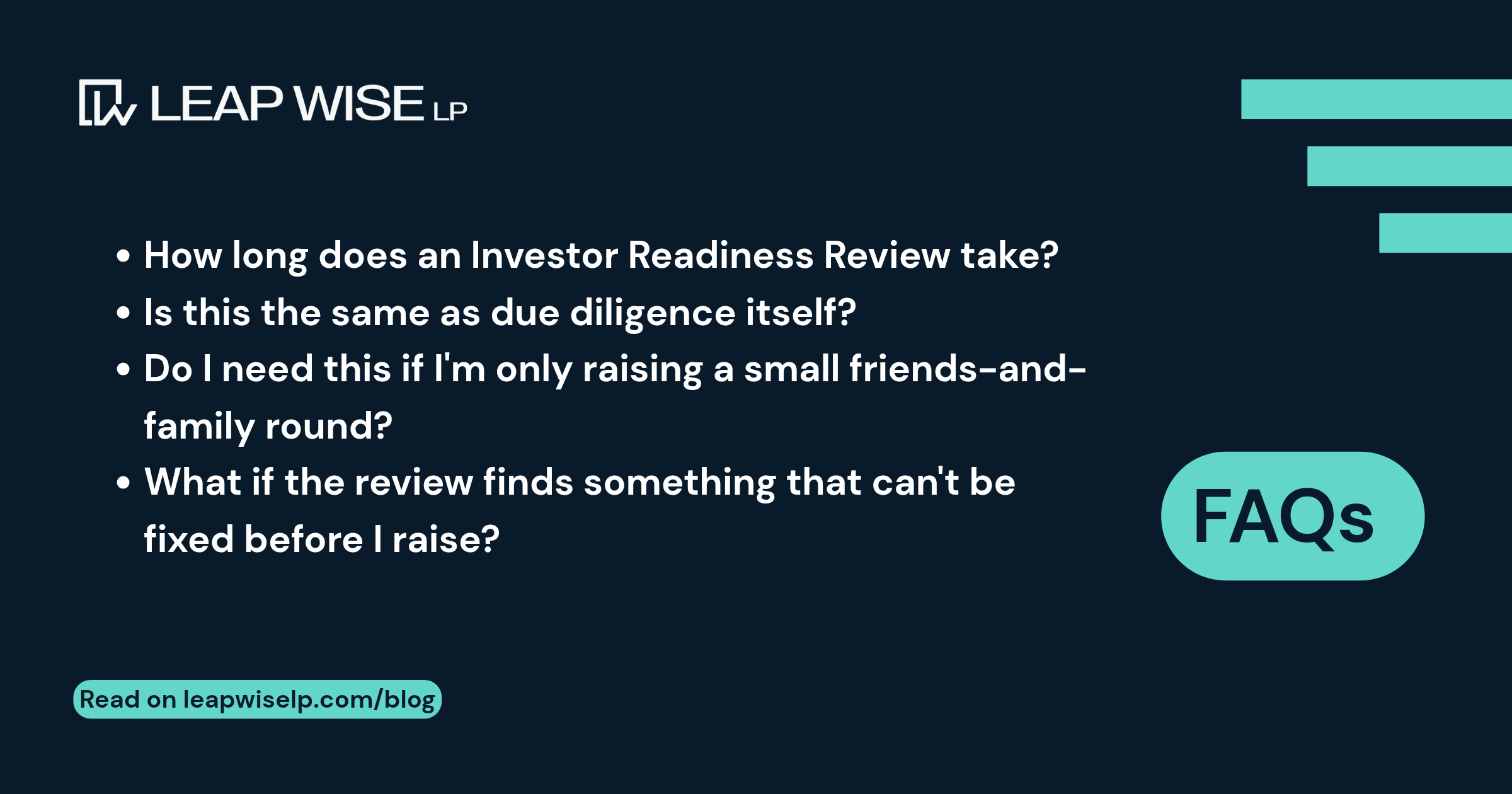
1. How long does an Investor Readiness Review take? The diagnosis and prioritisation stages typically take one to two weeks. Remediation depends entirely on what's found — administrative fixes close quickly, while ownership, IP issues involving third parties, or obtaining licences can take longer. Founders who start this before they have active investor conversations give themselves the most room.
2. Is this the same as due diligence itself? No. Due diligence is the investor's review of your business. An Investor Readiness Review is your own review, run before theirs, so you know what they'll find and have already addressed what you can.
3. Do I need this if I'm only raising a small friends-and-family round? The stakes are lower, but the underlying documentation still matters. Informal rounds are exactly where cap table and equity documentation gaps tend to originate, and they resurface at the next, larger raise if not corrected.
4. What if the review finds something that can't be fixed before I raise? Not every issue can be resolved on a founder's timeline. In that case, the value of the review is knowing what it is, understanding the risk, and being able to address it with an investor directly rather than have it surface as a surprise during their diligence.
More from the blog
 September 25, 2026Startup Legal Due Diligence Checklist: What Investors Actually Look At
 September 18, 2026What Does "Investor Ready" Actually Mean? A Founder's Guide to Legal Readiness Before You Raise
 August 19, 2026What Legal Support Does Your Startup Actually Need? A Stage-by-Stage Guide for Founders