
October 23, 2026 · 8 min read
Do You Need a Shareholders' Agreement Before You Raise? A Founder's Guide
Do You Need a Shareholders' Agreement Before You Raise?
Short answer: almost certainly yes, and later than most founders assume is fine.
The longer answer is more useful, because the question founders are usually really asking isn't "do I need this document." It's "am I already protected without it" — and the honest answer is: partially, but not where it counts.
The direct answer
Nigerian company law, through the Companies and Allied Matters Act 2020 (CAMA), already gives shareholders some default protections — pre-emptive rights on new share issuances, and remedies against oppressive conduct by majority shareholders. What it doesn't do is address the specific scenarios that cause most founder disputes: what happens if a co-founder leaves early, how decisions get made when founders disagree, what happens on an exit or sale, and whether a departing shareholder keeps 100% of their equity regardless of how little they contributed. A shareholders' agreement is where those answers live. Without one, they don't exist until a dispute forces a court to decide them — which is a far worse way to find out.
What CAMA already gives you, without an agreement
It's worth being precise here, because overstating the gap is as unhelpful as ignoring it.
Pre-emptive rights on new shares. Under Section 142 of CAMA, when a company proposes to issue new shares, it must first offer them to existing shareholders in proportion to their existing holdings, before offering them to anyone else. This is a real, mandatory protection — it exists whether or not you have a shareholders' agreement.
Protection against oppressive conduct. CAMA gives minority shareholders the right to petition the court where the company's affairs are being conducted in a manner that is oppressive or unfairly prejudicial to their interests, with courts having broad powers to grant remedies, including ordering a buy-out of shares.
Derivative actions. Where directors or majority shareholders breach their duties to the company and the board won't act, a shareholder can seek the court's permission to bring an action in the company's name.
These are genuine protections, and they matter. But notice what they have in common: they're reactive, general, and require a court. They tell you what happens if things go badly wrong and someone sues. They say nothing about how to prevent the dispute from reaching that point in the first place.
What only a shareholders' agreement actually covers
What happens if a founder leaves early
This is the single most common founder dispute, and CAMA has nothing specific to say about it. If a co-founder walks away eighteen months in, do they keep their full original equity? Most founders, asked directly, will say "obviously not, that wouldn't be fair" — but fairness isn't self-executing. Without a vesting schedule and leaver provisions written into a shareholders' agreement (or a related founder agreement), a departing co-founder keeps exactly what they were originally allotted, in full, indefinitely. The company is left with a significant, permanently fixed equity stake held by someone no longer involved.
How decisions actually get made
What requires unanimous founder agreement versus a simple majority? Can one founder unilaterally sign a major contract, take on debt, or bring in a new investor? Without this written down, disagreements default to whatever the loudest or most senior founder decides — which works until it doesn't.
What happens on a sale or exit
If one shareholder gets an offer to sell their stake, can the others block it, join it, or are they left with an unwanted new co-owner? A shareholders' agreement typically includes tag-along rights (minority shareholders can join a majority sale on the same terms) and can extend transfer restrictions beyond CAMA's default pre-emption rules — giving existing shareholders a proper right of first refusal on any proposed transfer, not just new issuances.
Deadlock between equal co-founders
Two 50/50 founders who disagree on a fundamental decision have no statutory tiebreaker. A shareholders' agreement can set out a deadlock resolution mechanism — arbitration, a casting vote, or a forced buy-out process — decided while the founders are getting along, not after they've stopped.
Reserved matters
Which decisions require shareholder approval rather than just board approval — raising debt above a certain amount, issuing new shares, changing the company's core business? Investors specifically look for this, because it tells them what protections they'll have as a minority shareholder once they invest.
Why investors ask for this specifically
An investor putting money into a company with two or three founders and no shareholders' agreement is, from their perspective, investing in a relationship with no rules. They don't know what happens if a founder leaves, they don't know how decisions get made, and they don't know what protections they'll have as a new minority shareholder. Most institutional and even serious angel investors will either require a shareholders' agreement to be in place as a condition of closing, or require one to be signed as part of the round itself — at which point you're negotiating founder-to-founder terms under the time pressure of a closing deal, rather than on your own schedule.
When to actually get one in place
The honest, slightly uncomfortable answer: as soon as there's more than one shareholder whose relationship actually matters to the business — which for most startups means at incorporation, or shortly after, not at the point of raising.
Waiting until a round is imminent isn't fatal, but it changes the negotiation. Getting a shareholders' agreement in place among co-founders who are getting along well is a straightforward drafting exercise. Getting one in place because an investor is requiring it as a closing condition, with a term sheet deadline attached, is a rushed negotiation where founders have far less room to think through scenarios properly — and less leverage to insist on terms that actually protect them if things go wrong.
A quick self-check
You likely need a shareholders' agreement — or need to update an existing one — if any of the following is true:
- More than one person holds meaningful equity and there's no written document governing what happens if one of them leaves
- There's no vesting schedule on founder equity
- Major decisions (raising debt, signing large contracts, bringing in new investors) aren't clearly assigned to a defined approval process
- There's no agreed mechanism for what happens if founders reach a genuine deadlock
- You're planning to raise and haven't confirmed whether your investor will require this as a closing condition
Common mistakes founders make
Assuming a good relationship makes the document unnecessary. The document only matters when the relationship is under strain — which is precisely when it's hardest to negotiate fairly if nothing was agreed in advance.
Treating it as an investor-facing formality rather than a founder protection. A shareholders' agreement protects founders from each other as much as it reassures investors. Founders who see it purely as a box to tick for fundraising often end up with a document that was drafted quickly and doesn't actually address their specific situation.
Confusing a founder agreement with a shareholders' agreement. They often overlap but aren't the same thing — a founder agreement typically covers roles, vesting, and IP; a shareholders' agreement governs the ownership and decision-making structure of the company itself, including any external shareholders. Depending on your structure, you may need one or both, properly aligned with each other.
When to get professional help
Drafting a shareholders' agreement from a template and adapting a few names is straightforward. Getting the vesting terms, deadlock mechanism, and transfer provisions right for your specific founder dynamic and investor expectations is where it becomes worth a proper legal review — particularly because this document is one investors and their lawyers will read closely during diligence.
Where Leap Wise fits
A missing or outdated shareholders' agreement is one of the more common gaps surfaced during investor due diligence, and one of the ones founders are best positioned to fix while relationships are still good. If you are preparing for fundraising, Leap Wise LP can review your corporate, contractual and compliance position — including whether your shareholder arrangements would hold up under investor scrutiny — and identify issues that may surface during investor due diligence.
FAQ
Do I need a shareholders' agreement if I'm the only shareholder? Not urgently — but plan for one before you bring in a co-founder, early investor, or anyone else who will hold shares. It's far easier to put the structure in place before the second shareholder joins than to renegotiate it afterward.
Can I use a generic template instead of a custom-drafted agreement? A template can be a reasonable starting point, but the terms that matter most — vesting schedules, deadlock provisions, reserved matters — need to actually reflect your founder dynamic and cap table, not a generic default. Investors' lawyers will notice a document that clearly wasn't adapted to the company.
Will my investor draft the shareholders' agreement for us? Sometimes an investor's lawyers will propose terms as part of the round, particularly around their own protective provisions. But the founder-level terms — what happens if a founder leaves, how the founders make decisions among themselves — are usually left for the foun
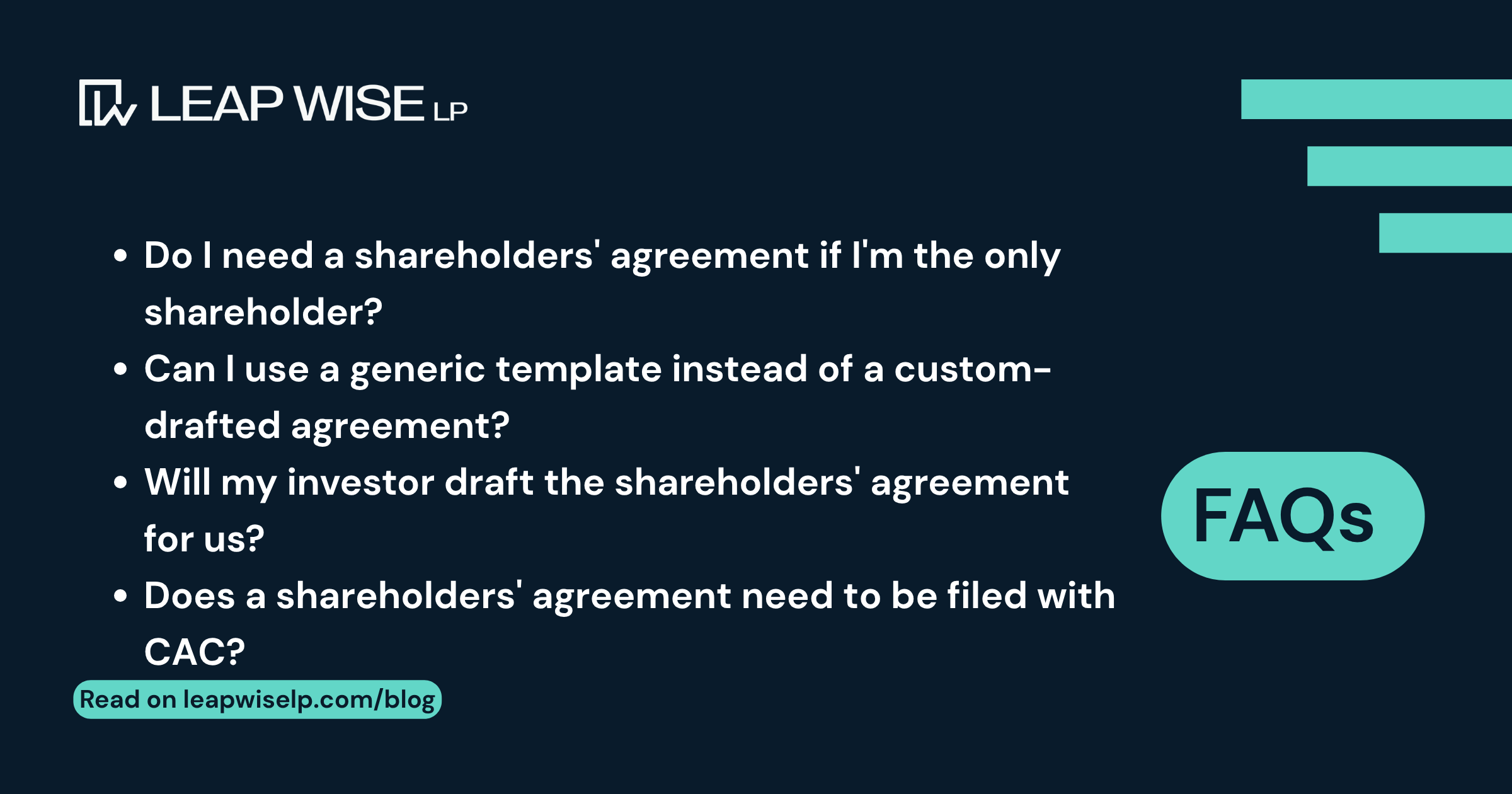
No — unlike the company's constitutional documents, a shareholders' agreement is a private contract between shareholders and doesn't need to be filed. That's also why it's easy for it to quietly not exist: nothing forces the question the way a CAC filing requirement would.
— If you are preparing for fundraising, Leap Wise LP can review your corporate, contractual and compliance position — including whether your shareholder arrangements would hold up under investor scrutiny — and identify issues that may surface during investor due diligence.


