
October 30, 2026 · 12 min read
Who Owns Your Startup's IP? Why This Question Decides Deals
Who Owns Your Startup's IP? Why This Question Decides Deals
Ask a founder who owns their product, and the answer comes without hesitation: the company does. Ask them to prove it — with a signed document, for every person who touched the code — and the confidence usually breaks down somewhere.
This isn't a paperwork detail. A startup's product is, in most cases, its only real asset. If the company doesn't have clean legal title to it, an investor isn't buying equity in a technology business. They're buying equity in a business that's using technology it may not actually own.
The direct answer
Under Nigerian law, ownership of a copyrighted work generally starts with the person who created it, not the person who paid for it or asked for it to be built — unless a contract says otherwise. This catches founders off guard in three specific, recurring situations: work built by contractors before a proper assignment was signed, work built by founders before the company existed, and trademarks registered in an individual's name instead of the company's. None of these are exotic edge cases. They are, in practice, the norm for startups that haven't had a legal review.
Why "we paid for it" doesn't mean "we own it"
The assumption most founders make is straightforward: the company commissioned the work, paid for it, so the company owns it. Under Nigerian copyright law, that assumption is often wrong, particularly for contractors and freelancers.
The general position is that copyright vests in the creator of a work — the author — from the moment it's created, whether that's an employee, a contractor, or a founder writing code on a laptop. For employees, the position generally shifts to the employer for work created in the course of their employment, though this is stronger and clearer for public-sector and government-related work than it is for straightforward private employment, which is why an explicit written term in the employment contract matters rather than relying on that default alone. For independent contractors and freelancers, the default tilts the other way: the person who wrote the code is treated as the owner of what they created, unless there's a written assignment transferring those rights to the company that commissioned it.
In other words: paying an invoice is not the same as owning what the invoice paid for.
Ownership, licensing and registration: three different things
Founders often use these words interchangeably. Investors don't, and the differences decide what your company can actually do with its IP.
1). Ownership means the company holds the rights itself. It can use, adapt, sell, license and enforce them. For copyright, ownership arises automatically when a work is created. Nothing needs to be registered, which is exactly why it's easy to assume it sits with the company when it doesn't. 2). Licensing means someone else owns the rights and gives the company permission to use them. A licence can be limited by purpose, duration, territory or exclusivity. Even an exclusive licence is not ownership. A contractor who "grants a licence" to the company has kept the IP, and the company may be unable to modify the product, transfer it in an acquisition, or stop the contractor reusing the code for others. Always check whether your contractor agreement assigns or only licenses. 3). Registration is a formal record with a registry. It matters most for trademarks, where Nigeria's first-to-file approach means the registered owner holds the stronger position. Registration doesn't create ownership of the underlying product, and the absence of registration doesn't mean you own nothing. It simply evidences and strengthens rights in some categories.
An investor will ask all three questions: who owns it, on what terms does the company hold anything it doesn't own, and is what should be registered registered in the right name?
The three situations that actually catch startups out
1. Contractor and outsourced development work
This is the most common and highest-stakes gap. Startups frequently build their first product with a freelance developer, a development agency, or a technical co-founder engaged as a contractor before formal employment terms existed. If that relationship was never governed by a written agreement that explicitly assigns IP ownership to the company, the default legal position is that the contractor — not the company — owns what they built.
In practice, this rarely causes a problem until it matters: a due diligence process, an acquisition, or a dispute with that contractor. At that point, the company can be in the position of needing to track down someone it worked with months or years ago, who may be uncooperative, unreachable, or aware that they're now holding something valuable.
What a developer or contractor agreement should cover A short "contractor will build X for a fee" agreement isn't enough. At a minimum, check that it includes:
- A written assignment of all IP in the work, including code, designs, documentation and anything created for the project, to the company, not just a licence to use it
- Clear scope, covering both work already delivered and future work, so earlier phases aren't left out
- Moral rights, with a waiver or consent to the extent the law permits
- Pre-existing and third-party material, including open-source code, with a warranty that the contractor has the right to use it and a disclosure of any licence terms that could affect the product
- Confidentiality obligations covering the company's data, specifications and know-how
- Further assurance, an obligation to sign whatever documents are later needed to perfect the company's title
- Handover, covering source code, repositories, credentials and documentation on completion or termination
- Subcontractors, requiring that anyone the contractor brings in is bound by the same terms
2. Work built before the company existed
Founders frequently start building before they incorporate — a natural sequence, since most people want to prove an idea works before registering a company around it. The problem is that IP created before incorporation belongs, by default, to the individual founders personally, not to the company. Incorporating the company does not automatically transfer that pre-existing IP into it. Unless there's a specific assignment — the founders formally transferring their pre-incorporation IP into the company, often as part of the incorporation process or an early shareholders' agreement — the company may be operating on technology it doesn't actually, legally own, even though every founder assumes it does.
Co-founders are the easiest contributors to overlook Founders are rarely thought of as a risk because everyone is aligned at the start. That is exactly why their IP is the least likely to be papered. Each founder who wrote code, designed the product or created the brand has personally contributed work the company may not own, and no one asks for an assignment from a friend. It becomes a problem when a founder leaves. A departed co-founder who never assigned their pre-incorporation work is in the same position as any outside contractor, except that the relationship is usually more strained and the company's dependence on their work is greater. The fix is simple while everyone is still on good terms. Have each founder sign an IP assignment to the company, whether in the incorporation documents or in an early shareholders' agreement. Pair it with vesting, so that a founder's equity and their contribution stay tied to the company. The same discipline applies to other early contributors such as designers, advisors and interns, who are easy to forget because they were never "hired".
3. Trademarks registered in the wrong name
Nigeria operates a first-to-file trademark system: rights generally go to whoever files the registration first, not necessarily whoever built the brand. This creates a specific, easy-to-miss risk — a founder registers the company's name or logo as a trademark in their own personal name, whether out of convenience, habit, or simply not realising the distinction matters, rather than in the name of the company. The brand the company has spent years building can end up legally owned by an individual, separate from the business itself.
Why this decides deals, not just documents
An investor isn't just checking whether IP ownership paperwork exists. They're checking whether the thing they're buying equity in — the product, the brand, the technology — is actually, legally, the company's to sell equity in.
If a due diligence review finds that a meaningful part of the product was built by a contractor with no signed assignment, that's not a formality to note and move past. It's a real risk: that contractor could, in theory, assert a claim over the product, license it elsewhere, or simply refuse to cooperate with a retroactive assignment unless compensated for it. Investors price that risk in, in one of a few ways — a lower valuation, a specific warranty or indemnity requiring the founders to resolve it, or in more serious cases, a condition that the gap be fixed before the round closes.
The riskiest version of this gap is the one involving a departed contributor. A former technical co-founder, an agency the company no longer works with, a freelancer from three years ago — the further removed the relationship, the harder and more expensive it becomes to secure a clean, cooperative assignment after the fact.
A practical review checklist
Work through this honestly, not optimistically:
- Every person who has written code, designed the product, or created core brand assets — list them, whether founder, employee, contractor, or agency
- For each one, confirm whether a written agreement exists that explicitly assigns IP ownership to the company
- Check whether any core product work predates the company's incorporation, and whether that pre-incorporation IP was formally assigned into the company afterward
- Confirm the company's trademarks — name, logo — are registered in the company's name, not an individual founder's
- Check current employment and contractor agreements for explicit, unambiguous IP assignment clauses, rather than relying on default legal positions that may not clearly apply
- Confirm whether each agreement assigns IP to the company or only licenses it, since a licence leaves ownership with the contractor
If any of these turns up a gap, particularly one involving someone no longer with the company, that's worth addressing before it becomes urgent.
Common mistakes founders make
Assuming a general services agreement covers IP. A contract that says "contractor will build X for a fee" doesn't necessarily assign ownership of what's built — IP assignment needs to be explicit, not inferred from the fact that work was commissioned and paid for.
Waiting to formalise assignments until they're needed. The best time to get a signed IP assignment from a contractor is while the relationship is active and cooperative. Reaching out months or years later, once the company suddenly needs the document for a raise or acquisition, is a materially harder conversation.
Registering trademarks personally "to save time." Even when the intention is to transfer it to the company later, this creates an unnecessary step — and risk — that a clean initial registration in the company's name avoids entirely.
When to get professional help
Reviewing every contributor's status and securing missing assignments is detailed, relationship-sensitive work — particularly for contributors who are no longer engaged with the company. It also requires judgment about which gaps are genuinely urgent versus lower risk, which isn't always obvious from the outside. This is exactly the kind of gap that's manageable to fix proactively and considerably harder to fix under the pressure of a live deal.
Where Leap Wise fits
IP ownership gaps are among the hardest due diligence findings to fix quickly, because they often depend on the cooperation of people no longer involved with the company. If you are preparing for fundraising, Leap Wise LP can review your corporate, contractual and compliance position — including whether your company actually holds clean legal title to its product and brand — and identify issues that may surface during investor due diligence.
FAQ
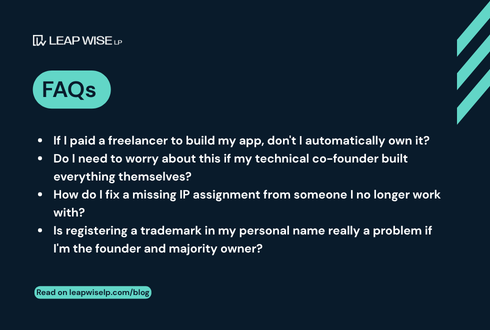
1). If I paid a freelancer to build my app, don't I automatically own it? Not necessarily. Under Nigerian copyright law, the default owner of a created work is often the person who created it, not the person who commissioned and paid for it, unless a written agreement explicitly assigns those rights to you.
2). Do I need to worry about this if my technical co-founder built everything themselves? Yes, if any of it was built before the company was incorporated. Pre-incorporation IP belongs to the individual, not the company, by default — incorporating the business doesn't automatically transfer it.
3). How do I fix a missing IP assignment from someone I no longer work with? It usually requires reaching out directly to formalise a retroactive assignment, which can range from straightforward to genuinely difficult depending on the relationship and how much leverage the other party realises they have. This is generally easier with legal support, both to draft the right document and to manage the conversation.
4). Is registering a trademark in my personal name really a problem if I'm the founder and majority owner? It creates unnecessary risk and complexity — particularly if your ownership changes, if you leave the company, or if an investor's diligence team flags that a core company asset is technically owned by an individual rather than the business. It's a straightforward fix, but one worth making before it becomes a question during a raise.
5). What's the difference between owning IP and having a licence to it? Owning IP means the company holds the rights itself and can use, modify, sell and enforce them. A licence is only permission to use something someone else still owns, and it can be limited by purpose, duration or territory. Even an exclusive licence is not ownership, which is why investors check whether a contractor agreement assigns IP or merely licenses it.
If you are preparing for fundraising, Leap Wise LP can review your corporate, contractual and compliance position — including whether your company actually holds clean legal title to its product and brand — and identify issues that may surface during investor due diligence.
Previous article: Do You Need a Shareholders' Agreement Before You Raise?
Next article: Investor Readiness Legal Services: How a Pre-Fundraising Legal Review Works


